
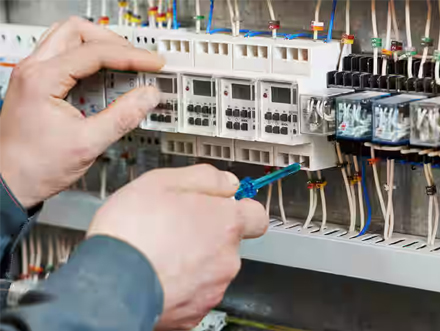
Panel Retro Fitting — Modernize Without Replacing
Our Panel Retro Fitting services modernize outdated electrical panels with the latest components, improving safety, performance, and reliability. Whether it's upgrading breakers, relays, or entire control systems, we deliver cost-effective solutions without the need for full panel replacement.
With 20 years of experience across industries including water treatment, mining, pharmaceuticals, and food processing, our engineers assess your existing panels, identify obsolete or degraded components, and execute precise retro-fitting upgrades that extend panel life and bring them up to current safety and performance standards.
Thorough on-site inspection of existing panels to evaluate current condition, identify obsolete components, assess safety compliance gaps, and determine feasibility of retro-fitting versus replacement.
Replacement of outdated breakers, relays, contactors, timers, and switches with modern equivalents — maintaining same footprint while upgrading to current technology and safety standards.
Migration from legacy PLC platforms to modern controllers — including program conversion, I/O mapping, HMI updates, and seamless integration with existing field wiring and instruments.
Full rewiring of panel interiors using quality-grade cables, proper glanding, ferruling, and numbering — eliminating ageing insulation, loose connections, and wiring hazards.
Installation and integration of Variable Frequency Drives for motor control — enabling energy savings, soft starting, speed control, and process optimization within existing panel infrastructure.
Delivery of updated Single Line Diagrams (SLD), wiring drawings, component schedules, and as-built documentation reflecting all modifications made during the retro-fitting process.
Comprehensive post-retrofit testing including insulation resistance (megger) testing, continuity checks, full load testing, and commissioning support to ensure reliable operation.
Ensuring all retro-fitted panels meet current electrical safety standards — proper earthing, IP rating compliance, safety interlocks, warning labels, and adherence to IS/IEC norms.